BioAcyl Corp

BioAcyl Corp |
|
 |
 |
 |
|
Chakraborty, S., Sampath, D., & Yu Lin, M. O. (2021). Agrin-Matrix Metalloproteinase-12 axis confers a mechanically competent microenvironment in skin wound healing. Nature Communications, 12(1), 6349. Added by: Dr. Enrique Feoli (05/08/2022, 11:40) Last edited by: Dr. Enrique Feoli (05/08/2022, 11:58) |
 |
| Resource type: Journal Article Published DOI: 10.1038/s41467-021-26717-7 ID no. (ISBN etc.): 2041-1723 BibTeX citation key: Chakraborty2021 View all bibliographic details  |
Categories: BioAcyl Corp Subcategories: Wound Healing Creators: Chakraborty, Sampath, Yu Lin Collection: Nature Communications |
Views: 20/310
|
| Abstract |
|
An orchestrated wound healing program drives skin repair via collective epidermal cell proliferation and migration. However, the molecular determinants of the tissue microenvironment supporting wound healing remain poorly understood. Herein we discover that proteoglycan Agrin is enriched within the early wound-microenvironment and is indispensable for efficient healing. Agrin enhances the mechanoperception of keratinocytes by augmenting their stiffness, traction stress and fluidic velocity fields in retaliation to bulk substrate rigidity. Importantly, Agrin overhauls cytoskeletal architecture via enhancing actomyosin cables upon sensing geometric stress and force following an injury. Moreover, we identify Matrix Metalloproteinase-12 (MMP12) as a downstream effector of Agrin’s mechanoperception. We also reveal a promising potential of a recombinant Agrin fragment as a bio-additive material that assimilates optimal mechanobiological and pro-angiogenic parameters by engaging MMP12 in accelerated wound healing. Together, we propose that Agrin-MMP12 pathway integrates a broad range of mechanical stimuli to coordinate a competent skin wound healing niche.
|
| Notes |
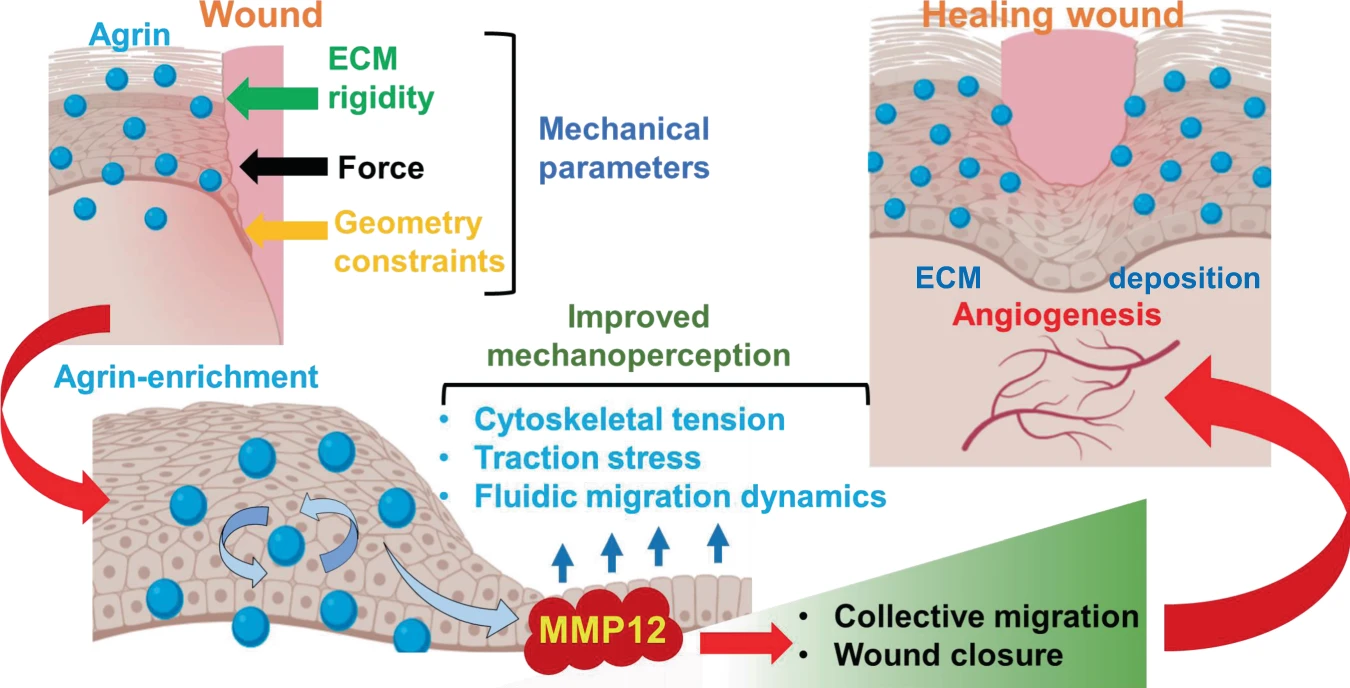
Agrin sensitizes the wounded cells towards ECM rigidity, force recognition, and geometric constraints accounting for improved traction stress, elasticity, and cytoskeletal tension to promote enhanced fluid-like dynamic collective migration (blue arrows) over the wounded sites. Further, Agrin activates MMP12 as its downstream effector to upgrade the mechanoperception of keratinocytes and actomyosin integrity during keratinocyte migration. The cumulative outcome of an Agrin-driven mechanically competent wound healing micro-environment yields higher collective migration and wound closure via facilitating re-epithelization, optimal ECM deposition, and angiogenesis. Added by: Dr. Enrique Feoli Last edited by: Dr. Enrique Feoli |