BioAcyl Corp

BioAcyl Corp |
|
 |
 |
 |
|
Iwasaki, A., Foxman, E. F., & Molony, R. D. (2017). Early local immune defenses in the respiratory tract. Nat. Rev. Immunol. 17(1), 7. Added by: Dr. Enrique Feoli (17/06/2021, 15:17) Last edited by: Dr. Enrique Feoli (17/06/2021, 17:44) |
 |
| Resource type: Journal Article Published DOI: 10.1038/nri.2016.117 BibTeX citation key: Iwasaki2017 View all bibliographic details  |
Categories: BioAcyl Corp Subcategories: URT Immunity Creators: Foxman, Iwasaki, Molony Collection: Nat. Rev. Immunol. |
Views: 23/332
|
| Abstract |
|
The respiratory immune response consists of multiple tiers of cellular responses that are engaged in a sequential manner in order to control infections. Stepwise engagement of effector functions with progressively increasing host fitness costs limits tissue damage. In addition, specific mechanisms are in place to promote disease tolerance in response to respiratory infections. Environmental factors, obesity and the ageing process can alter the efficiency and regulation of this tiered response, increasing pathology and mortality as a result. In this Review, we describe the cell types that coordinate pathogen clearance and tissue repair through serial secretion of cytokines, and discuss how the environment and comorbidity influence this response.
|
| Notes |
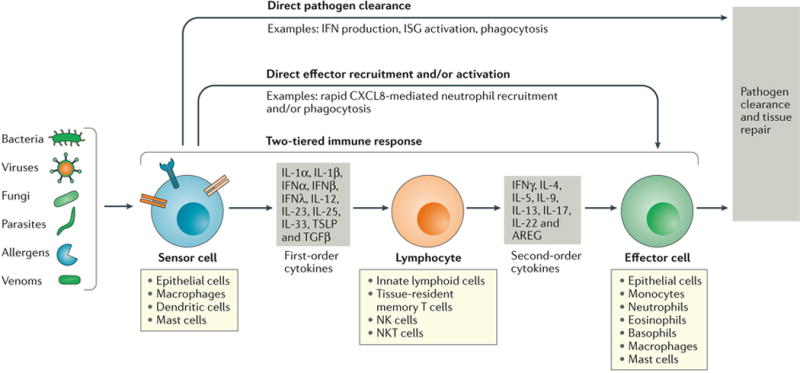
A stepwise engagement of tiered responses following respiratory infection Pathogens and certain noxious compounds are detected by sensor cells located within the respiratory tract. Sensor cells immediately initiate innate immune responses that may be sufficient to clear localized infections. For example, sensor cells may secrete factors such as interferons (IFNs) that lead to pathogen clearance (direct pathogen clearance, top arrow). In some cases, first order cytokines directly recruit effector cells that clear pathogens; for example, CXCL8 mediate recruitment of neutrophils to clear bacteria (direct effector recruitment and/or activation, second arrow from the top). In addition, a two-tiered response can be engaged, in which sensor cells secrete first order cytokines that act on tissue-resident lymphoid cell populations, which integrate these signals and release appropriate second order cytokines. These cytokines in turn recruit and activate effector cells and effector functions specific to the pathogen type, which serve to promote pathogen clearance and tissue repair. |