BioAcyl Corp

BioAcyl Corp |
|
 |
 |
 |
|
Ordovas-Montanes, J., Beyaz, S., Rakoff-Nahoum, S., & others. (2020). Distribution and storage of inflammatory memory in barrier tissues. Nat. Rev. Immunol. 20(5), 308. Added by: Dr. Enrique Feoli (27/01/2021, 02:00) Last edited by: Dr. Enrique Feoli (03/02/2021, 00:27) |
 |
| Resource type: Journal Article Published DOI: 10.1038/s41577-019-0263-z BibTeX citation key: OrdovasMontanes2020 View all bibliographic details  |
Categories: BioAcyl Corp, BioAcyl Corp Subcategories: Inflammatory memory, Inmunidad de mucosas Creators: Beyaz, Ordovas-Montanes, others, Rakoff-Nahoum Collection: Nat. Rev. Immunol. |
Views: 20/450
|
| Abstract |
|
Memories of previous immune events enable barrier tissues to rapidly recall distinct environmental exposures. To effectively inform future responses, these past experiences can be stored in cell types that reside long-term in tissues or are essential.
|
| Notes |
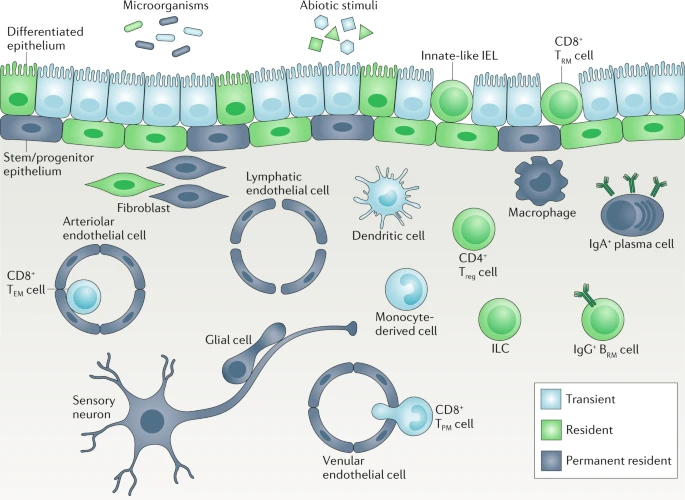
Cell type residence and permanence in barrier tissues. The cell types in a tissue at any given moment may be there short-term (transient cells), have capacity to reside long-term in a tissue (resident cells) or be essential constituents (permanent resident cells). The fundamental permanent resident unit of a barrier tissue consists of epithelial stem cells and stromal cells (fibroblasts and endothelial cells). Other permanent resident cells include macrophages and sensory neurons. We acknowledge that there are specific cases where cell subsets that are typically transient (such as monocyte-derived mononuclear phagocytes) can acquire the characteristics of resident cells (such as Langerhans cells or macrophages) based on environmental perturbation and niche availability. Cell types that are non-essential to the fundamental tissue unit (plasma cells) can also exhibit characteristics of permanent residence. Moreover, microorganisms can also be permanent residents, residents or transient, and abiotic stimuli such as nutritional components can vary in “residence” based on the frequency and duration of environmental exposure.
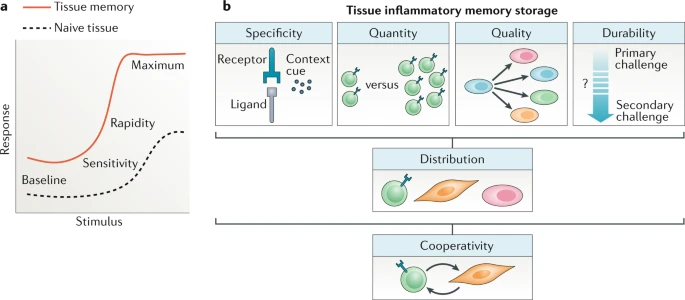
Properties of tissue inflammatory memory storage. a ∣ The properties of memory to a stimulus include increases in baseline, sensitivity, rapidity or maximum response. Graphic adapted with permission from REF. 11 © Elsevier. b ∣ The discrete components of tissue inflammatory memory storage include specificity, quantity, quality (i.e. cell state), durability and distribution among various cell types. Cooperativity may exist across similar or distinct cell types, with each cell type being defined through its own discrete components.
Added by: Dr. Enrique Feoli Last edited by: Dr. Enrique Feoli |
| Quotes |
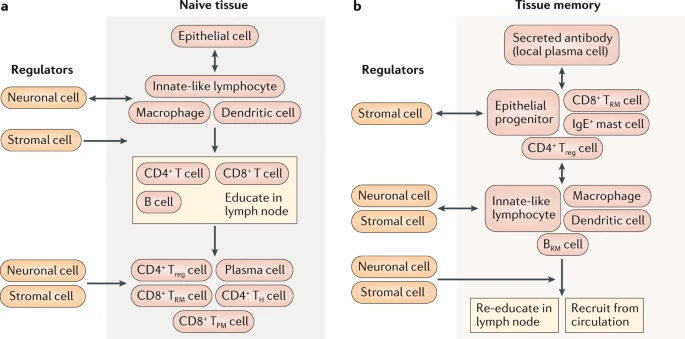
The flow of information through a naive tissue (part a) or a hypothetical experienced tissue (part b), in which memory has been established, with key regulators at each step highlighted on the side of the vertical flow. Arrows indicate the predominant direction of information flow. By establishing memory in specific cell subsets, such as antibody-producing plasma cells, resident memory CD8+ T cells and epithelial progenitors, the typical flow of information can be ‘inverted’ in a tissue that has inflammatory memory. BRM cell, tissue-resident memory B cell; TH cell, T helper cell; TPM cell, peripheral memory T cell; Treg cell, regulatory T cell; TRM cell, tissue-resident memory T cell.
Added by: Dr. Enrique Feoli
(03/02/2021, 00:24)
|