BioAcyl Corp

BioAcyl Corp |
|
 |
 |
 |
|
Loscalzo, J., & Barabasi, A.-L. (2011). Systems Biology and the Future of Medicine. Wiley Interdiscip. Rev. Syst. Biol. Med. 3(6), 619. Added by: Dr. Enrique Feoli (12/01/2021, 01:24) Last edited by: Dr. Enrique Feoli (28/01/2026, 17:13) |
 |
| Resource type: Journal Article Published DOI: 10.1002/wsbm.144 BibTeX citation key: Loscalzo2011 View all bibliographic details  |
Categories: BioAcyl Corp Subcategories: Systems Biology Creators: Barabasi, Loscalzo Collection: Wiley Interdiscip. Rev. Syst. Biol. Med. |
Views: 24/335
|
| Abstract |
|
Contemporary views of human disease are based on simple correlation between clinical syndromes and pathological analysis dating from the late 19th century. While this approach to disease diagnosis, prognosis, and treatment has served the medical establishment and society well for many years, it has serious shortcomings for the modern era of the genomic medicine that stem from its reliance on reductionist principles of experimentation and analysis. Quantitative, holistic systems biology applied to human disease offers a unique approach for diagnosing established disease, defining disease predilection, and developing individualized (personalized) treatment strategies that can take full advantage of modern molecular pathobiology and the comprehensive data sets that are rapidly becoming available for populations and individuals. In this way, systems pathobiology offers the promise of redefining our approach to disease and the field of medicine.
Added by: Dr. Enrique Feoli Last edited by: Dr. Enrique Feoli |
| Notes |

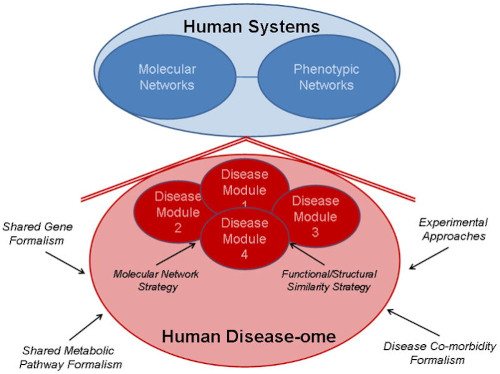
The Human Systems Biology Universe
Human systems comprise molecular and phenotypic networks, which are related to, but distinct from, each other, as indicated by the separate linked ovals. The human disease-ome represents a collection of subnetworks, the disease modules, which are identified by one of two strategies, the molecular network-based strategy or the functional and structural similarity-based strategy. The assembly of disease modules into the disease-ome can be determined by bioinformatics-based approaches– the shared gene formalism, the shared metabolic pathway formalism, or the disease co-morbidity formalism —or by laboratory-based experimentation.
Added by: Dr. Enrique Feoli Last edited by: Dr. Enrique Feoli |