
BioAcyl Corp

WIKINDX Resources

Hwang, J. Y., Randall, T. D., & Silva-Sanchez, A. (2016). Inducible Bronchus-Associated Lymphoid Tissue: Taming Inflammation in the Lung. Frontiers in immunology, 7. 
Added by: Dr. Enrique Feoli (30/09/2020, 17:31)   Last edited by: Dr. Enrique Feoli (15/01/2023, 16:27)
Resource type: Journal Article
DOI: 10.3389/fimmu.2016.00258
ID no. (ISBN etc.): 1664-3224
BibTeX citation key: Hwang2016
View all bibliographic details
Categories: BioAcyl Corp
Subcategories: Inmunidad de mucosas
Creators: Hwang, Randall, Silva-Sanchez
Collection: Frontiers in immunology
Views: 3/273
Abstract
Following pulmonary inflammation, leukocytes that infiltrate the lung often assemble into structures known as inducible Bronchus-Associated Lymphoid Tissue (iBALT). Like conventional lymphoid organs, areas of iBALT have segregated B and T cell areas, specialized stromal cells, high endothelial venules and lymphatic vessels. After inflammation is resolved, iBALT is maintained for months, independently of inflammation. Once iBALT is formed, it participates in immune responses to pulmonary antigens, including those that are unrelated to the iBALT-initiating antigen, and often alters the clinical course of disease. However, the mechanisms that govern immune responses in iBALT and determine how iBALT impacts local and systemic immunity are poorly understood. Here we review our current understanding of iBALT formation and discuss how iBALT participates in pulmonary immunity.
  
Notes

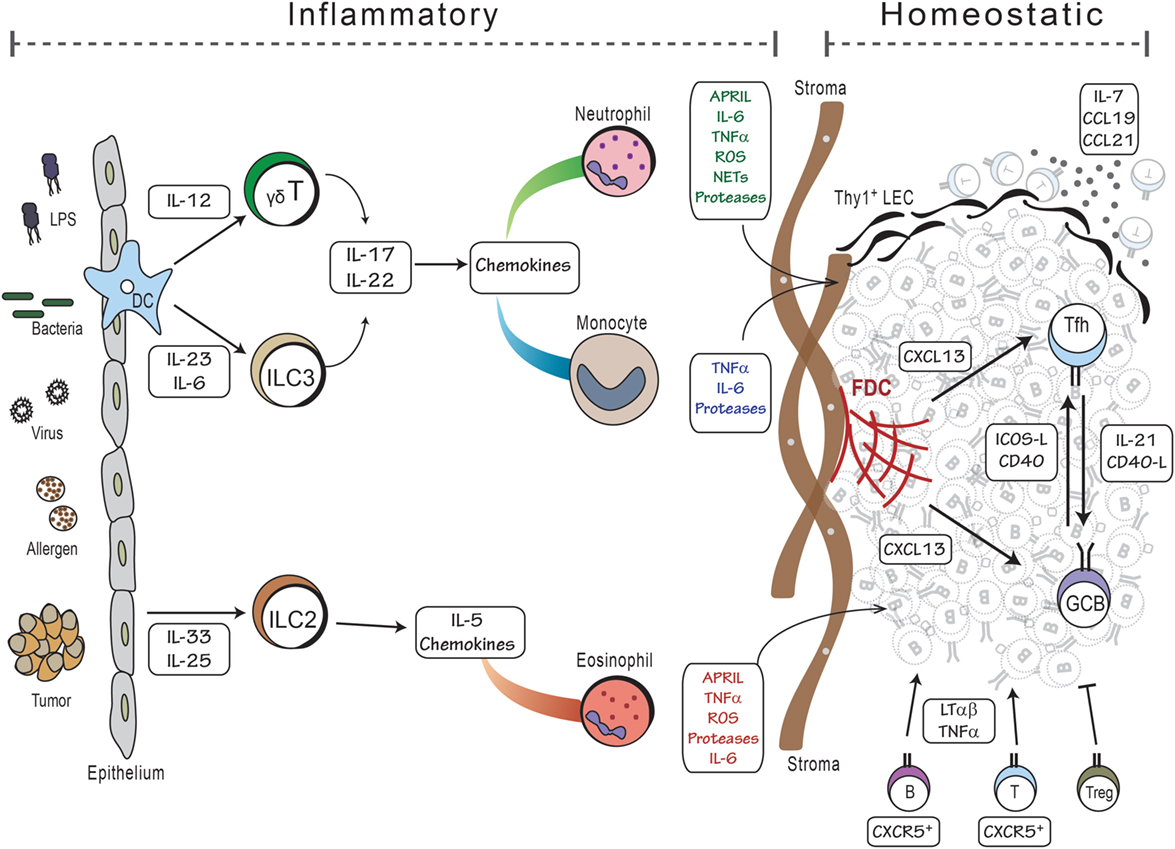
 MODEL OF IBALT DEVELOPMENT. The development of iBALT can be initiated by a wide variety of stimuli, including microbial products, bacteria, viruses, allergens, tumors, and particulates (left side), which trigger the activation and cytokine production from epithelial cells and dendritic cells. Innate cells, such as ILCs and γδT cells, become activated and produce cytokines and chemokines that attract inflammatory cells like neutrophils, monocytes, and eosinophils. Granulocytes produce cytokines that promote B cell activation as well as proteases and reactive oxygen that activate stromal cell precursors. These activities would all occur during an inflammatory process. Once mature B and T cells are recruited to the lung, they reinforce the differentiation of stromal cells into mature FDCs and FRCs that respectively support the B and T cell areas of iBALT. Once inflammation is resolved, the lymphocytes, dendritic cells, and stromal cells can maintain the iBALT structure using homeostatic mechanisms – lymphotoxin and chemokines – for months.


Added by: Dr. Enrique Feoli  Last edited by: Dr. Enrique Feoli
WIKINDX 6.12.1 | Total resources: 1701 | Username: -- | Bibliography: WIKINDX Master Bibliography | Style: American Psychological Association (APA) | Time Zone: America/Costa_Rica (-06:00)