BioAcyl Corp

BioAcyl Corp |
|
 |
 |
 |
|
Cho, C. J., Brown, J. W., & Mills, J. C. (2024). Origins of cancer: Ain’t it just mature cells misbehaving? The EMBO Journal, 43(13), 2530–2551. Added by: Dr. Enrique Feoli (21/07/2026, 20:00) Last edited by: Dr. Enrique Feoli (21/07/2026, 20:14) |
 |
| Resource type: Journal Article Published DOI: 10.1038/s44318-024-00099-0 ID no. (ISBN etc.): 1460-2075 BibTeX citation key: Cho2024 View all bibliographic details  |
Categories: BioAcyl Corp Subcategories: Cell plasticity Creators: Brown, Cho, Mills Collection: The EMBO Journal |
Views: 60/296
|
| Abstract |
|
A pervasive view is that undifferentiated stem cells are alone responsible for generating all other cells and are the origins of cancer. However, emerging evidence demonstrates fully differentiated cells are plastic, can be coaxed to proliferate, and also play essential roles in tissue maintenance, regeneration, and tumorigenesis. Here, we review the mechanisms governing how differentiated cells become cancer cells. First, we examine the unique characteristics of differentiated cell division, focusing on why differentiated cells are more susceptible than stem cells to accumulating mutations. Next, we investigate why the evolution of multicellularity in animals likely required plastic differentiated cells that maintain the capacity to return to the cell cycle and required the tumor suppressor p53. Finally, we examine an example of an evolutionarily conserved program for the plasticity of differentiated cells, paligenosis, which helps explain the origins of cancers that arise in adults. Altogether, we highlight new perspectives for understanding the development of cancer and new strategies for preventing carcinogenic cellular transformations from occurring.
Added by: Dr. Enrique Feoli Last edited by: Dr. Enrique Feoli |
| Notes |
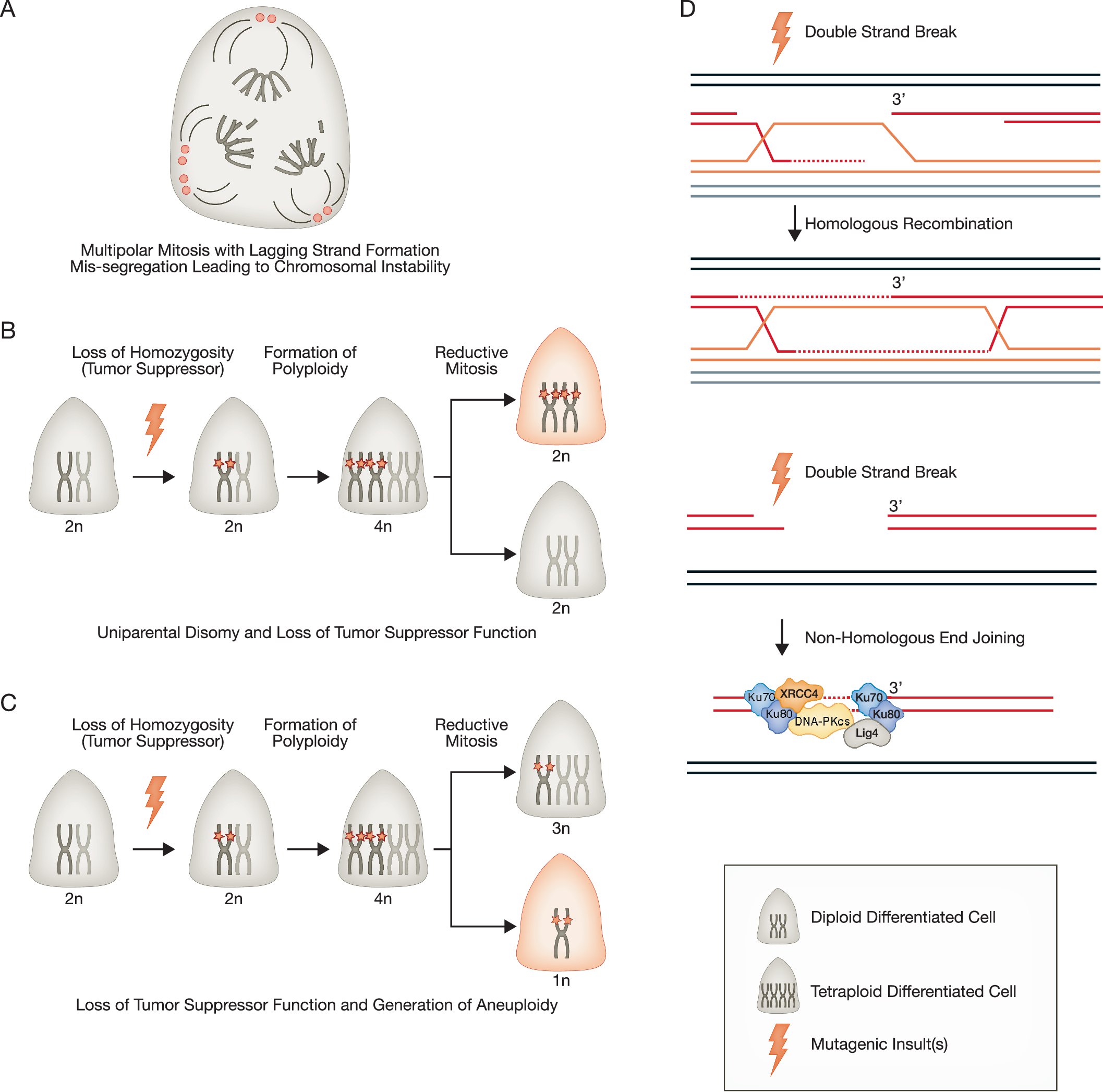
As differentiated cells are often polyploid or multinucleated, their mitosis may take several aberrant paths: (A) multipolar mitosis with lagging strand formation and mis-segregation leading to increased chromosomal instability; (B) uniparental disomy and premature loss of tumor suppressor function; (C) premature loss of tumor suppressor function and generation of aneuploidy. (D) Upon DNA damage, differentiated cells rely on error-prone DNA damage repair mechanisms such as nonhomologous end joining (lower) rather than error-free homologous recombination (upper), which is the only possible when sister chromosome is available. Added by: Dr. Enrique Feoli Last edited by: Dr. Enrique Feoli |