BioAcyl Corp

BioAcyl Corp |
|
 |
 |
 |
|
Kobayashi, J. (2022). Nitric oxide bioavailability and insulin resistance: an overview. In Challenges and Advances in Pharmaceutical Research Vol. 8. BP International. Added by: Dr. Enrique Feoli (02/03/2026, 14:29) Last edited by: Dr. Enrique Feoli (02/03/2026, 15:06) |
 |
| Resource type: Book Chapter Published ID no. (ISBN etc.): 978-93-5547-807-8 BibTeX citation key: Kobayashi2022 View all bibliographic details  |
Categories: BioAcyl Corp Subcategories: Entero-salivary cycle Creators: Kobayashi Publisher: BP International Collection: Challenges and Advances in Pharmaceutical Research Vol. 8 |
Views: 23/113
|
| Abstract |
|
The aim of this review are to discusses the mechanisms by which insulin resistance develops in the presence of increased adiposity, to summarize the causative relationship between impaired NO bioavailability and insulin resistance, and also to show the implications of life-style changes to prevent insulin resistance. Obesity with increased visceral adiposity is an inflammatory condition that leads to insulin resistance. Because the insulin signalling pathway is linked to endothelial nitric oxide synthase (eNOS) activation, insulin resistance is always associated with decreased nitric oxide (NO) bioavailability. Recently, accumulating evidence has suggested that physical exercise and dietary nitrate/nitrite diets rich in vegetables improve insulin resistance by enhancing NO bioavailability, and thus provide potential preventive and therapeutic options for these patients with insulin resistance. Added by: Dr. Enrique Feoli |
| Notes |
|
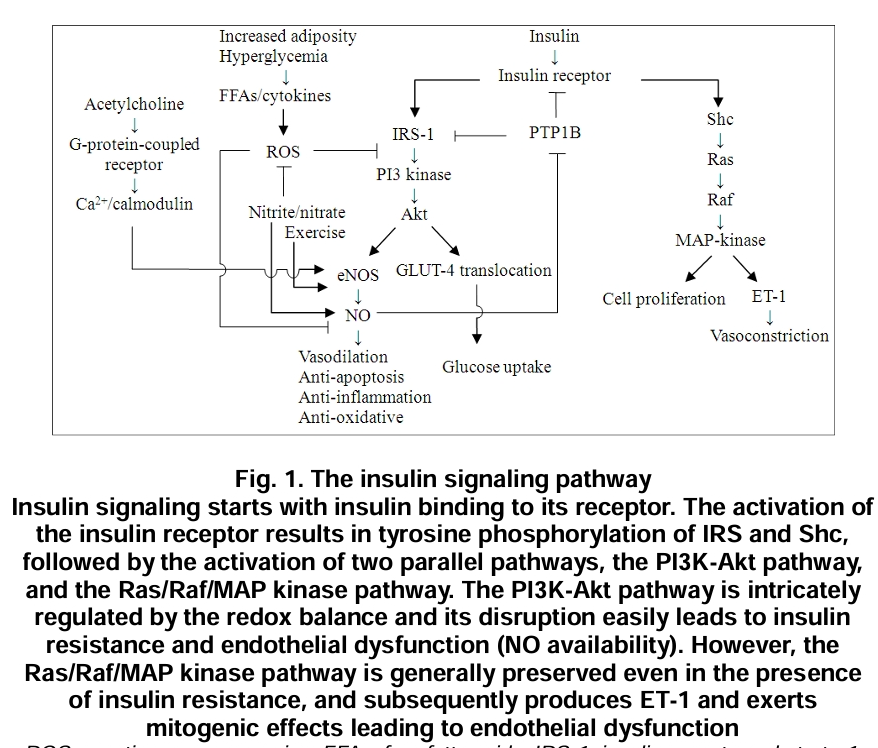
Accumulating evidence has suggested that the defect responsible for insulin resistance lies mostly at the post-receptor level of insulin signaling [71] (Fig. 1). Many kinases and phosphatases associated with the insulin signaling pathways are intricately regulated and balanced by protein phosphorylation/ dephosphorylation and nitrosation [17]. Increased adiposity causes an oxidative shift in the intracellular redox environment [69], and impairs the early steps of the insulin signaling pathway [72]. Wang et al recently indicated that NO mediates S nitrosation of protein-tyrosine phosphatase 1B (PTPB1) and enhances the effects of insulin [57]. Because PTPB1 dephosphorylates the insulin receptor and its substrates, attenuating the effects of insulin, its phosphatase activity tends to be suppressed by eNOS-mediated S-nitrosation. In contrast, once the vascular eNOS activity is impaired, PTPB1 suppresses the downstream signaling to PI3K/Akt, leading to insulin resistance (Fig. 1). Therefore, NO might act as a 84 Challenges and Advances in Pharmaceutical Research Vol. 8 Nitric Oxide Bioavailability and Insulin Resistance: An Overview regulatory factor for the downstream signaling molecules linking GLUT4 translocation and glucose uptake [66,73]. In addition, Jiang recently reported that the NO-dependent nitrosation of GLUT4 facilitates GLUT4 translocation to the membrane for glucose uptake and improves insulin resistance [27,74].
Added by: Dr. Enrique Feoli Last edited by: Dr. Enrique Feoli |