BioAcyl Corp

BioAcyl Corp |
|
 |
 |
 |
|
Wang, S., & Qin, L. (2022). Homeostatic medicine: A strategy for exploring health and disease. Current Medicine, 1(1), 16. Added by: Dr. Enrique Feoli (17/02/2026, 20:28) Last edited by: Dr. Enrique Feoli (21/02/2026, 10:18) |
 |
| Resource type: Journal Article Published DOI: 10.1007/s44194-022-00016-9 ID no. (ISBN etc.): 2731-0868 BibTeX citation key: Wang2022 View all bibliographic details  |
Categories: BioAcyl Corp Subcategories: Entero-salivary cycle, Homeostasis, Sialic acids Keywords: sialin Creators: Qin, Wang Collection: Current Medicine |
Views: 32/131
|
| Abstract |
|
Homeostasis is a process of dynamic balance regulated by organisms, through which they maintain an internal stability and adapt to the external environment for survival. In this paper, we propose the concept of utilizing homeostatic medicine (HM) as a strategy to explore health and disease. HM is a science that studies the maintenance of the body’s homeostasis. It is also a discipline that investigates the role of homeostasis in building health, studies the change of homeostasis in disease progression, and explores ways to restore homeostasis for the prevention, diagnosis and treatment of disease at all levels of biological organization. A new dimension in the medical system with a promising future HM focuses on how homeostasis functions in the regulation of health and disease and provides strategic directions in disease prevention and control. Nitric oxide (NO) plays an important role in the control of homeostasis in multiple systems. Nitrate is an important substance that regulates NO homeostasis through the nitrate-nitrite-NO pathway. Sialin interacts with nitrate and participates in the regulation of NO production and cell biological functions for body homeostasis. The interactions between nitrate and NO or sialin is an important mechanism by which homeostasis is regulated.
Added by: Dr. Enrique Feoli Last edited by: Dr. Enrique Feoli |
| Notes |
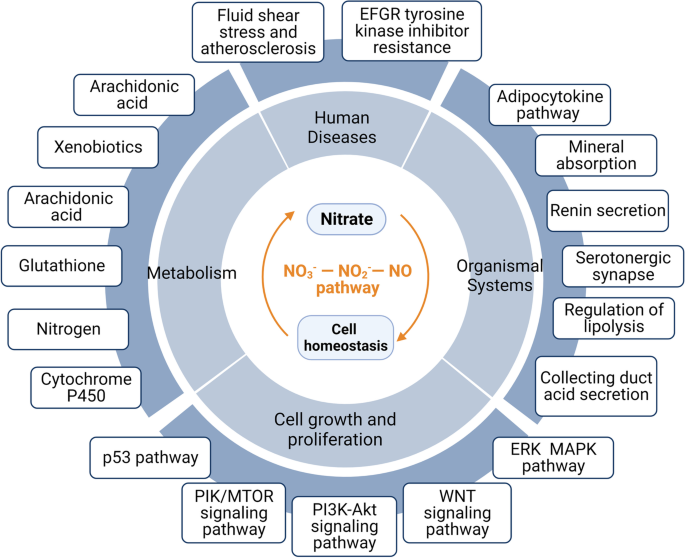
Signaling pathways and functions of nitrate on the regulation of homeostasis. Through the nitrate-nitrite-NO pathway, nitrate plays an important role in regulating homeostasis of cells from multiple perspectives, including regulating metabolism, promoting cell regeneration, and inhibiting disease progression Added by: Dr. Enrique Feoli Last edited by: Dr. Enrique Feoli |