BioAcyl Corp

BioAcyl Corp |
|
 |
 |
 |
|
Nguyen, T. Q. T., & Cho, K. A. (2025). Targeting immunosenescence and inflammaging: Advancing longevity research. Experimental \& Molecular Medicine, 1–12. Added by: Dr. Enrique Feoli (12/09/2025, 00:19) Last edited by: Dr. Enrique Feoli (12/09/2025, 00:27) |
 |
| Resource type: Journal Article Published DOI: 10.1038/s12276-025-01527-9 ID no. (ISBN etc.): 2092-6413 BibTeX citation key: Nguyen2025 View all bibliographic details  |
Categories: BioAcyl Corp, BioAcyl Corp Subcategories: Ageing, Inflammaging Keywords: Biological therapy, Drug development, Immunological techniques, Translational immunology Creators: Cho, Nguyen Collection: Experimental \& Molecular Medicine |
Views: 32/141
|
| Abstract |
|
Here we examine the crucial role of the immune system in aging, with a particular focus on two interconnected processes: immunosenescence and inflammaging, which contribute to age-related decline. Our goal is to provide a thorough overview of the various factors that lead to immune aging while introducing therapeutic approaches that can partially restore immune function. Additionally, we discuss recent strategies that go beyond localized immune improvement to actively modulate immune balance, influencing systemic aging and extending healthspan. Through this exploration, we propose that regulating the immune system is essential for managing immune aging and may serve as a key mechanism for controlling the overall aging process and promoting healthy longevity.
|
| Notes |
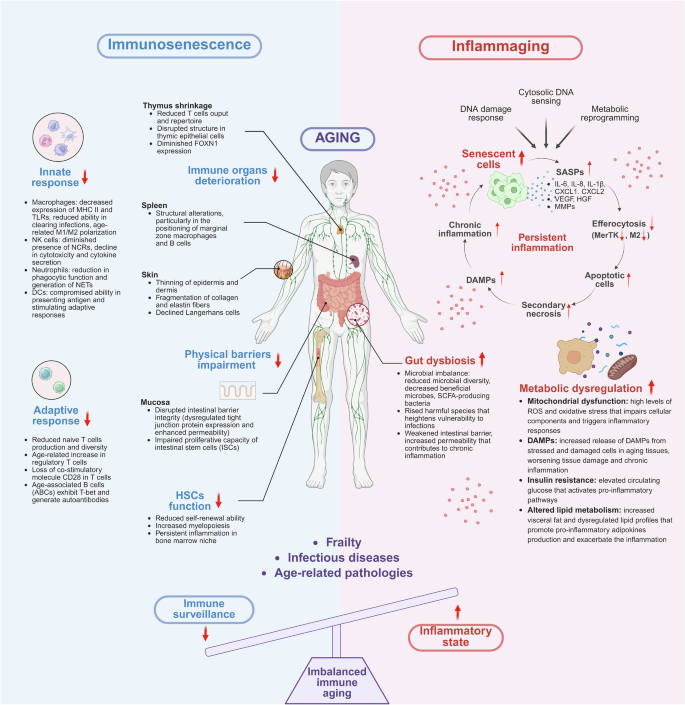 This schematic illustrates the two major immune-aging axes—immunosenescence and inflammaging—and their systemic impact on organismal aging. Immunosenescence is marked by deterioration of immune organs (for example, thymus, spleen and skin), impaired physical and mucosal barriers, reduced HSC function and weakened innate and adaptive immune responses. In parallel, inflammaging arises from persistent inflammation driven by senescent cell accumulation, SASP secretion, metabolic dysregulation, mitochondrial dysfunction and gut dysbiosis. Together, these processes promote immune imbalance, leading to increased vulnerability to infections, frailty and age-related diseases. This schematic illustrates the two major immune-aging axes—immunosenescence and inflammaging—and their systemic impact on organismal aging. Immunosenescence is marked by deterioration of immune organs (for example, thymus, spleen and skin), impaired physical and mucosal barriers, reduced HSC function and weakened innate and adaptive immune responses. In parallel, inflammaging arises from persistent inflammation driven by senescent cell accumulation, SASP secretion, metabolic dysregulation, mitochondrial dysfunction and gut dysbiosis. Together, these processes promote immune imbalance, leading to increased vulnerability to infections, frailty and age-related diseases.
Added by: Dr. Enrique Feoli Last edited by: Dr. Enrique Feoli |