BioAcyl Corp

BioAcyl Corp |
|
 |
 |
 |
|
Zhu, F., & Nie, G. (2025). Cell reprogramming: Methods, mechanisms and applications. Cell Regeneration, 14(1), 12. Added by: Dr. Enrique Feoli (23/07/2025, 21:06) Last edited by: Dr. Enrique Feoli (23/07/2025, 21:08) |
 |
| Resource type: Journal Article Published DOI: 10.1186/s13619-025-00229-x ID no. (ISBN etc.): 2045-9769 BibTeX citation key: Zhu2025 View all bibliographic details  |
Categories: BioAcyl Corp Keywords: Biophysical regulation, cancer immunotherapy, Cell reprogramming, Cell therapy, Disease modeling, Drug development Creators: Nie, Zhu Collection: Cell Regeneration |
Views: 122/426
|
| Abstract |
|
Cell reprogramming represents a powerful approach to achieve the conversion cells of one type into cells of another type of interest, which has substantially changed the landscape in the field of developmental biology, regenerative medicine, disease modeling, drug discovery and cancer immunotherapy. Cell reprogramming is a complex and ordered process that involves the coordination of transcriptional, epigenetic, translational and metabolic changes. Over the past two decades, a range of questions regarding the facilitators/barriers, the trajectories, and the mechanisms of cell reprogramming have been extensively investigated. This review summarizes the recent advances in cell reprogramming mediated by transcription factors or chemical molecules, followed by elaborating on the important roles of biophysical cues in cell reprogramming. Additionally, this review will detail our current understanding of the mechanisms that govern cell reprogramming, including the involvement of the recently discovered biomolecular condensates. Finally, the review discusses the broad applications and future directions of cell reprogramming in developmental biology, disease modeling, drug development, regenerative/rejuvenation therapy, and cancer immunotherapy.
|
| Notes |
|
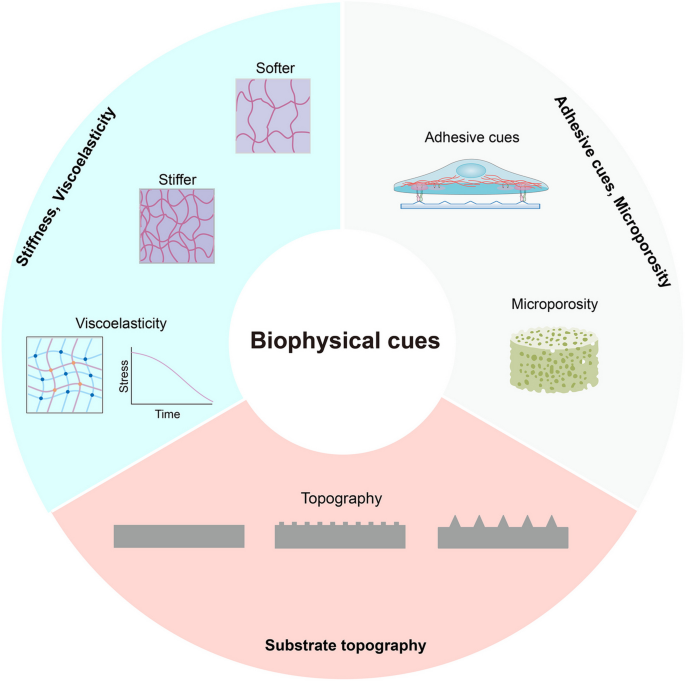
Different forms of biophysical cues from functional biomaterials. The important roles of biophysical cues, such as substrate stiffness, substrate topography, viscoelasticity, adhesive properties, or microporosity in cell reprogramming are increasingly recognized |