BioAcyl Corp

BioAcyl Corp |
|
 |
 |
 |
|
Cliff, T. S., & Dalton, S. (2017). METABOLIC SWITCHING AND CELL FATE DECISIONS: IMPLICATIONS FOR PLURIPOTENCY, REPROGRAMMING AND DEVELOPMENT. Current opinion in genetics \& development, 46, 44–49. Added by: Dr. Enrique Feoli (12/07/2025, 20:06) Last edited by: Dr. Enrique Feoli (12/07/2025, 20:12) |
 |
| Resource type: Journal Article Published DOI: 10.1016/j.gde.2017.06.008 ID no. (ISBN etc.): 0959-437X BibTeX citation key: Cliff2017 View all bibliographic details  |
Categories: BioAcyl Corp, BioAcyl Corp Subcategories: Cell plasticity, Paligenosis Creators: Cliff, Dalton Collection: Current opinion in genetics \& development |
Views: 23/100
|
| Abstract |
|
Cell fate decisions are closely linked to changes in metabolic activity. Over recent years this connection has been implicated in mechanisms underpinning embryonic development, reprogramming and disease pathogenesis. In addition to being important for supporting the energy demands of different cell types, metabolic switching from aerobic glycolysis to oxidative phosphorylation plays a critical role in controlling biosynthetic processes, intracellular redox state, epigenetic status and reactive oxygen species levels. These processes extend beyond ATP synthesis by impacting cell proliferation, differentiation, enzymatic activity, ageing and genomic integrity. This review will focus on how metabolic switching impacts decisions made by multipotent cells and discusses mechanisms by which this occurs.
|
| Notes |
|
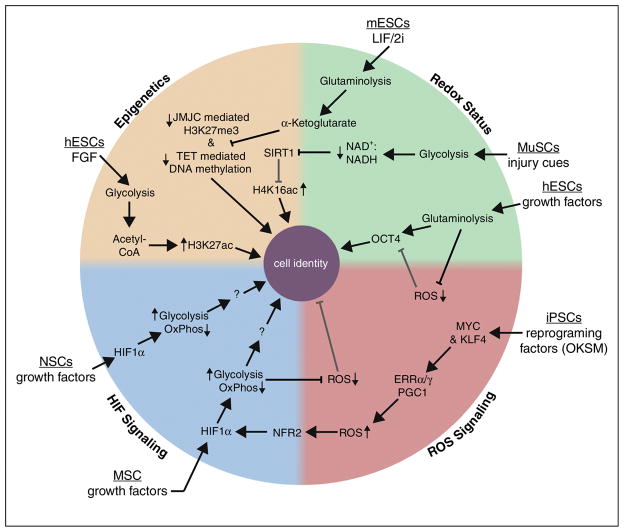
Extracellular signaling pathways, generated in human and mouse embryonic stem cells (hPSCs and mPSCs, respectively), muscle satellite stem cells (MuSCs), induced pluripotent stem cells (iPSCs), mesenchymal stem cells (MSCs), and neural stem cells (NSCs) modulate intracellular metabolic pathways. Metabolic flux then regulates cell identity through one or more of four main pathways: epigenetics [orange], redox status [green], reactive oxygen signaling (ROS) signaling [red], hypoxia induced factor (HIF) signaling [blue]. Large arrows with open arrowheads represent activating signals while repressive signals are marked by barred lines. Grey lines represent pathways that are repressed by aerobic glycolysis or glutaminolysis. Small arrows with closed arrowheads indicate whether that adjacent pathway, metabolite, signaling molecule, epigenetic mark, or metabolite ratio is increased or decreased. Abbreviations: mouse embryonic stem cells (mESCs), leukemia inhibitory factor (LIF), PD0325901 and CHIR99021 inhibitors (2i), Jumonji C domain-containing proteins (JMJC), ten eleven translocation enzymes (TET), human embryonic stem cells (hESCs), fibroblast growth factor (FGF), muscle satellite stem cells (MuSC), ratio of oxidized to reduced nicotinamide adenine dinucleotide (NAD+:NADH), NAD-dependent deacetylase sirtuin 1 (SIRT1), octamer-binding transcription factor 4 (OCT4), Kruppel like factor 4 (KLF4), reprograming factors: OCT4, KLF4, Sex determining region Y-box 2, MYC (OKSM), estrogen-related receptor α and γ (ERRα/γ), nuclear factor, erythroid 2 like 2 (NFR2), oxidative phosphorylation (OxPhos), mesenchymal stem cells (MSCs), neural stem cells (NSCs) |