BioAcyl Corp

BioAcyl Corp |
|
 |
 |
 |
|
Nguyen, T., Mills, J. C., & Cho, C. J. (2023). The coordinated management of ribosome and translation during injury and regeneration. Frontiers in Cell and Developmental Biology, Volume 11 - 2023. Added by: Dr. Enrique Feoli (16/06/2025, 00:37) Last edited by: Dr. Enrique Feoli (16/06/2025, 00:42) |
 |
| Resource type: Journal Article Published DOI: 10.3389/fcell.2023.1186638 ID no. (ISBN etc.): 2296-634X BibTeX citation key: Nguyen2023 View all bibliographic details  |
Categories: BioAcyl Corp Subcategories: Paligenosis Creators: Cho, Mills, Nguyen Collection: Frontiers in Cell and Developmental Biology |
Views: 20/90
|
| Abstract |
|
Diverse acute and chronic injuries induce damage responses in the gastrointestinal (GI) system, and numerous cell types in the GI tract demonstrate remarkable resilience, adaptability, and regenerative capacity in response to stress or partial cell loss. Metaplasias, such as columnar and secretory cell metaplasia, are well-known adaptations that these cells make, the majority of which are epidemiologically associated with an elevated cancer risk. On a number of fronts, it is now being investigated how cells respond to injury at the tissue level, where diverse cell types that range in proliferation capacity and differentiation state cooperate and compete with one another to participate in regeneration. In addition, the cascades or series of molecular responses that cells show, especially in differentiated cells, are just beginning to be understood. This will facilitate the discovery of novel therapeutic targets for GI tract tumors. Ribosomes are ribonucleoprotein complexes that are essential for translation in the endoplasmic reticulum (ER) and cytoplasm. The highly regulated management of ribosomes as key translational machinery, and their crucial platform of rough ER, are not only essential for maintaining differentiated cell identity, but also for achieving successful cell regeneration after injury. This review will cover in depth how ribosomes, the ER, and translation are regulated and managed in response to injury (e.g., paligenosis), as well as why this is essential for the proper adaptation of a cell to stress. For this, we will first discuss the general stress responsive pattern of various cell types in multiple GI organs, followed by an overview of ribosome production, management, and degradation, as well as the factors that govern ribosomes and the ER during homeostasis and injury, and finally, how ribosomes and translation machineries are managed during injury.
|
| Notes |
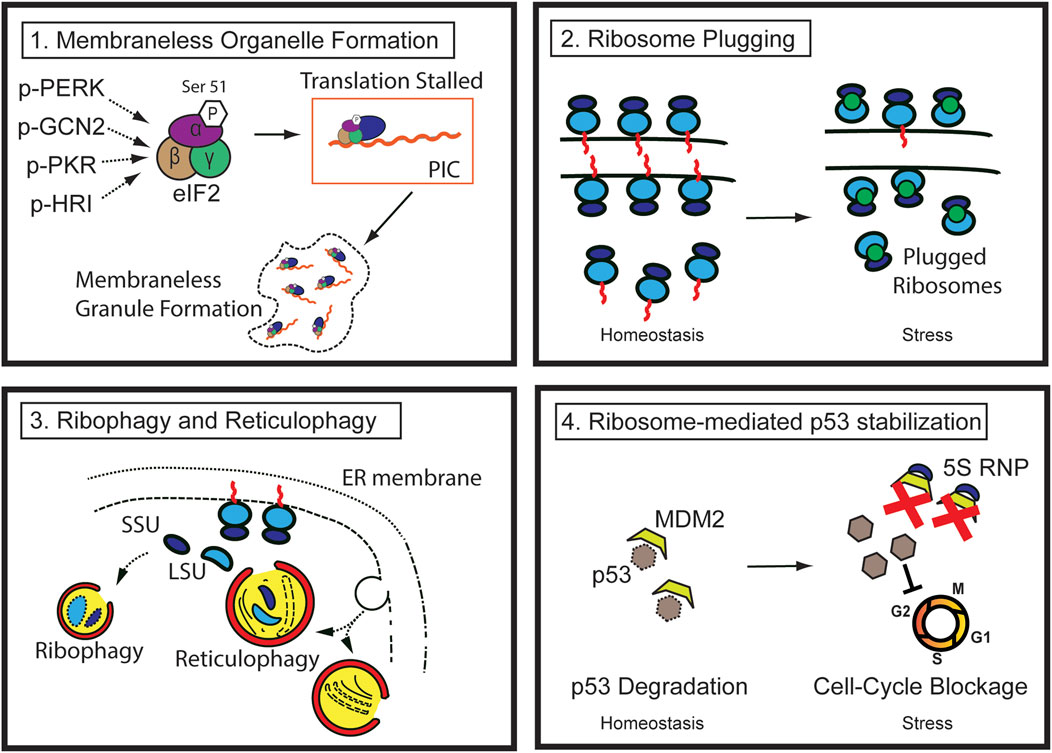
Pathways of ribosome regulation during injury (1) During stress, multiple kinases phosphorylate the Serine 51 residue of eIF2 alpha, reducing translation efficiency. The stalled preinitiation complex can be localized to membraneless granules, such as stress granules. (2) Ribosome degradation can be prevented by ribosome-plugging proteins (green circles), the majority of which are evolutionarily conserved. (3) Ribosomes in the cytosol and those attached to the rough ER are susceptible to autophagic destruction through ribophagy and reticulophagy. (4) Ribosomal proteins (such as RPL5 and 11) and 5S ribosomal RNA complex (5S RNP) from degraded ribosomes or other errors in ribosome biogenesis stabilize p53 by sequestering and inhibiting MDM2, ultimately blocking cell cycle progression. Added by: Dr. Enrique Feoli Last edited by: Dr. Enrique Feoli |