BioAcyl Corp

BioAcyl Corp |
|
 |
 |
 |
|
Buenrostro-Jáuregui, M. H., Muñóz-Sánchez, S., & Rojas-Hernández, J. (2025). A comprehensive overview of stress, resilience, and neuroplasticity mechanisms. International Journal of Molecular Sciences, 26(3028). Added by: Dr. Enrique Feoli (12/06/2025, 00:30) Last edited by: Dr. Enrique Feoli (12/06/2025, 00:54) |
 |
| Resource type: Journal Article Published DOI: 10.3390/ijms26073028 ID no. (ISBN etc.): 1422-0067 BibTeX citation key: BuenrostroJauregui2025 View all bibliographic details  |
Categories: BioAcyl Corp Subcategories: Stress resistant phenotype Creators: Buenrostro-Jáuregui, Muñóz-Sánchez, Rojas-Hernández Collection: International Journal of Molecular Sciences |
Views: 21/96
|
| Abstract |
|
Stress is a core concept in the mental health field that expands upon the seminal definition of stress as an acute response to the disruption of homeostasis. Stress is a complex process that involves both environmental challenges and the triggering of internal responses and impacts physiological, psychological, and behavioral systems. The capacity of the human brain to cope with stress is particularly crucial in early life, when neurodevelopment is highly plastic. Early-life stress (ELS), defined as exposure to severe chronic stress during sensitive periods of development, has been shown to cause lasting changes in brain structure and function. However, not all individuals exposed to ELS develop pathological outcomes, suggesting the presence of resilience mechanisms: adaptive processes that allow an individual to cope with adverse situations while maintaining psychological and neurobiological health. The aim of this review was to synthesize recent advances in the understanding of the neuroplasticity mechanisms underlying resilience to ELS. We discussed the neurobiological pathways implicated in stress response and adaptation, including the roles of neurogenesis, synaptic plasticity, and neural circuit remodeling. By focusing on the interplay between stress-induced neuroplastic changes and resilience mechanisms, we aimed to provide insights into potential therapeutic targets for stress-related psychopathology.
|
| Notes |
|
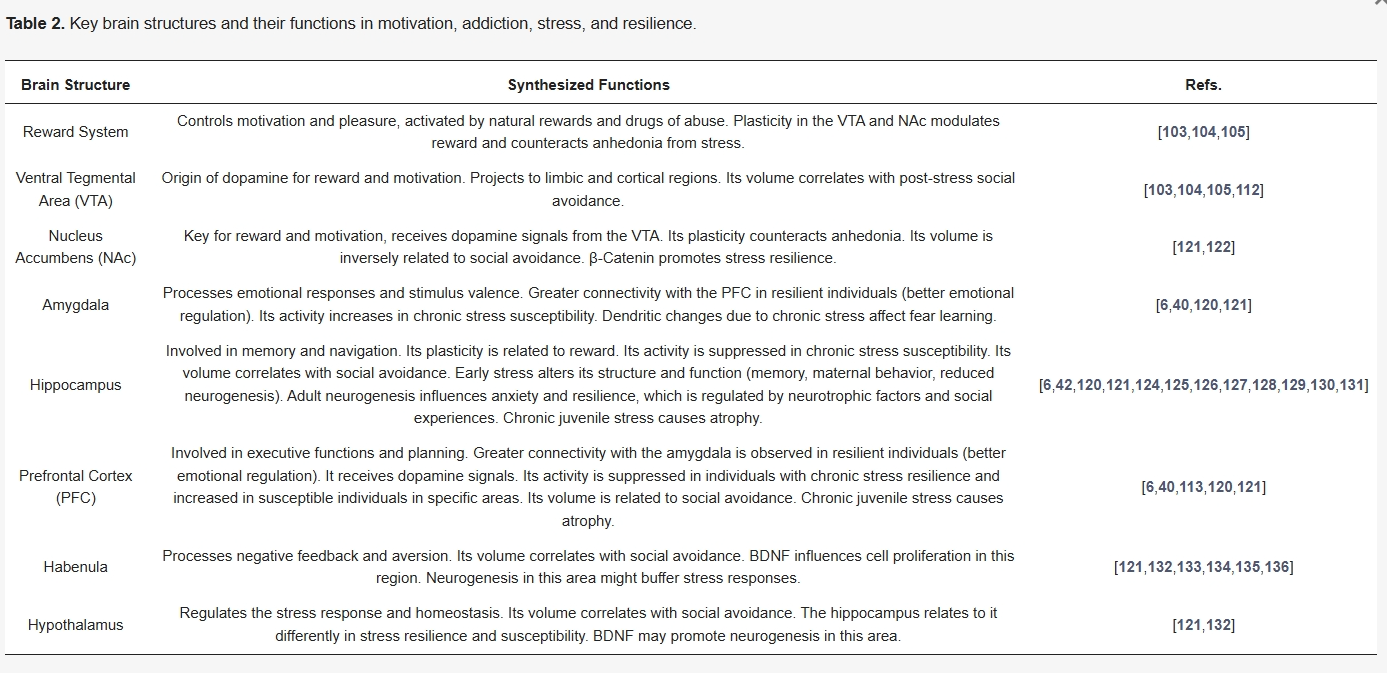
Schematic representation of the major mesocorticolimbic pathways in the human brain. This diagram illustrates key neural circuits involved in reward, motivation, and emotion, highlighting different neurotransmitter systems within these pathways in the human brain. Dopaminergic pathways (purple), glutamatergic pathways (orange), GABAergic pathways (green), and opioid pathways (blue) are shown. PFC, prefrontal cortex, which is involved in executive functions, planning, and decision-making; NAc, nucleus accumbens, a key area in the reward circuitry associated with pleasure and motivation; Hyp, hypothalamus, which regulates various bodily functions, including the stress response and homeostasis; VTA, ventral tegmental area, which is the origin of the mesocorticolimbic dopamine pathway that is crucial for reward and motivation; Hb, habenula, which is involved in processing negative feedback and aversion; Amy, amygdala, which plays a central role in processing emotions, particularly fear and anxiety; and Hippo, hippocampus, which is essential for memory formation and spatial navigation.
Added by: Dr. Enrique Feoli Last edited by: Dr. Enrique Feoli |