BioAcyl Corp

BioAcyl Corp |
|
 |
 |
 |
|
Levine, Y. A., Faltys, M., & Chernoff, D. (2020). Harnessing the Inflammatory Reflex for the Treatment of Inflammation-Mediated Diseases. Cold Spring Harbor Perspectives in Medicine, 10(1), a034330. Added by: Dr. Enrique Feoli (01/05/2025, 16:48) Last edited by: Dr. Enrique Feoli (01/05/2025, 16:55) |
 |
| Resource type: Journal Article Published DOI: 10.1101/cshperspect.a034330 ID no. (ISBN etc.): 2157-1422 BibTeX citation key: Levine2020 View all bibliographic details  |
Categories: BioAcyl Corp Subcategories: Gut-origin Sepsis Creators: Chernoff, Faltys, Levine Collection: Cold Spring Harbor Perspectives in Medicine |
Views: 23/86
|
| Abstract |
|
Treating diseases nonpharmacologically, using targeted neurostimulation instead of systemic drugs, is a hallmark of the burgeoning field of bioelectronic medicine. In this review, we provide a brief overview of the discovery and function of the prototypical neuroimmune reflex, the “inflammatory reflex.” We discuss various biomarkers developed and used to translate early physiological discoveries into dosing parameters used in experimental settings, from the treatment of animal models of disease through a proof-of-concept clinical study in rheumatoid arthritis (RA). Finally, we relate how unique aspects of this form of therapy enabled the design of a next-generation implanted pulse generator using integrated electrodes, currently under evaluation in a U.S.-based clinical study for patients with drug refractory RA.
|
| Notes |
|
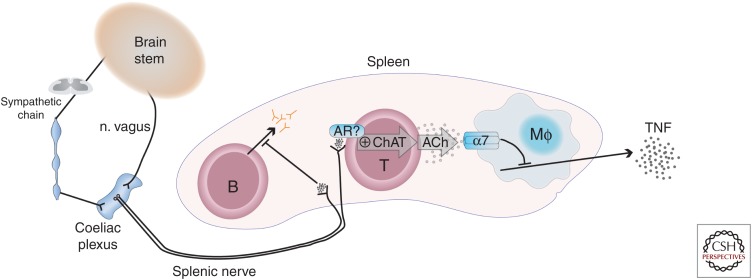
Model of the cholinergic anti-inflammatory pathway (CAP), the efferent arc of the inflammatory reflex. Signals from the brainstem travel through the vagus nerve to the celiac plexus, which also receives input from the sympathetic trunk. The splenic nerve arises in the coeliac plexus and projects to the spleen. Choline acetyltransferase (ChAT)-expressing T and B cells are found in proximity of splenic nerve terminals. Motor signals in the vagus nerve activate the splenic nerve, which releases norepinephrine, activating ChAT+ T cells through adrenergic receptors (ARs), and induces the production and release of T-cell-derived acetylcholine (ACh). This ACh then acts on the α7 nicotinic ACh receptors on macrophages and other immune cells and suppresses release of the tumor necrosis factor (TNF). (Reprinted, with permission, from Olofsson et al. 2012b, © Wiley.) Added by: Dr. Enrique Feoli Last edited by: Dr. Enrique Feoli |