BioAcyl Corp

BioAcyl Corp |
|
 |
 |
 |
|
Pang, Y., Wu, L., & Tang, C. (2022). Autophagy-inflammation interplay during infection: Balancing pathogen clearance and host inflammation. Frontiers in Pharmacology, 13. Added by: Dr. Enrique Feoli (15/04/2024, 18:01) Last edited by: Dr. Enrique Feoli (15/04/2024, 18:04) |
 |
| Resource type: Journal Article Published DOI: 10.3389/fphar.2022.832750 ID no. (ISBN etc.): 1663-9812 BibTeX citation key: Pang2022 View all bibliographic details  |
Categories: BioAcyl Corp Subcategories: Autophagy and mitophagy Creators: Pang, Tang, Wu Collection: Frontiers in Pharmacology |
Views: 20/148
|
| Abstract |
|
Inflammation is an essential immune response of the host against infections but is often over-activated, leading to a variety of disorders. Autophagy, a conserved degradation pathway, also protects cells by capturing intracellular pathogens that enter the cell and transporting them to the lysosome for clearance. Dysfunctional autophagy is often associated with uncontrolled inflammatory responses during infection. In recent years, more and more research has focused on the crosstalk between autophagy and inflammation. In this paper, we review the latest research advances in this field, hoping to gain insight into the mechanisms by which the body balances autophagy and inflammation in infections and how this mechanism can be used to fight infections better.
|
| Notes |
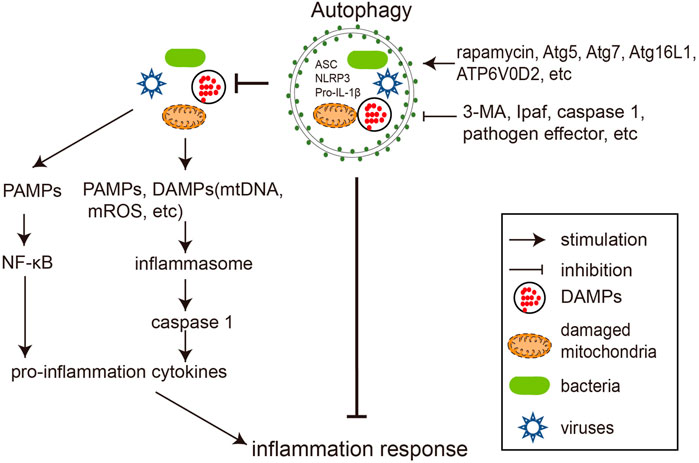
Crosstalks between autophagy and inflammation during pathogen infections. Bacterial and viral infections trigger inflammation by activating NF-κB signaling and inflammasome. Autophagy negatively regulates inflammation by degrading its stimuli, including bacteria, viruses, DAMPs, and inflammasome components. Rapamycin and overexpression of autophagy genes (such as Atg5, Atg7, Atg16L1, and ATP6V0D2) reduce inflammation by promoting autophagy, while 3-MA, inflammasome components (e.g., Ipaf, Caspase-1) and pathogen encoded proteins preserve inflammation by antagonizing autophagy. Added by: Dr. Enrique Feoli Last edited by: Dr. Enrique Feoli |