BioAcyl Corp

BioAcyl Corp |
|
 |
 |
 |
|
Swain, S. L., McKinstry, K. K., & Strutt, T. M. (2012). Expanding roles for CD4+ T cells in immunity to viruses. Nature Reviews Immunology, 12(2), 136–148. Added by: Dr. Enrique Feoli (27/06/2023, 19:45) Last edited by: Dr. Enrique Feoli (15/10/2023, 17:39) |
 |
| Resource type: Journal Article Published DOI: 10.1038/nri3152 ID no. (ISBN etc.): 1474-1741 BibTeX citation key: Swain2012 View all bibliographic details  |
Categories: BioAcyl Corp, BioAcyl Corp Subcategories: Inflammatory memory, Tcell types Cell-mediated effector immunity Creators: McKinstry, Strutt, Swain Collection: Nature Reviews Immunology |
Views: 18/317
|
| Abstract |
|
CD4+ T cells are orchestrators, regulators and direct effectors of antiviral immunity.Neutralizing antibodies provide protection against many viral pathogens, and CD4+ T cells can help B cells to generate stronger and longer-lived antibody responses.CD4+ T cells help antiviral CD8+ T cells in two main ways: they maximize CD8+ T cell population expansion during a primary immune response and also facilitate the generation of virus-specific memory CD8+ T cell populations.In addition to their helper functions, CD4+ T cells contribute directly to viral clearance. They secrete cytokines with antiviral activities and, in some circumstances, can eliminate infected cells through cytotoxic killing.Memory CD4+ T cells provide superior protection during re-infection with a virus. Compared with new effector CD4+ T cells, memory CD4+ T cells have enhanced helper and effector functions and can rapidly trigger innate immune defence mechanisms early in the infection.
|
| Notes |
|
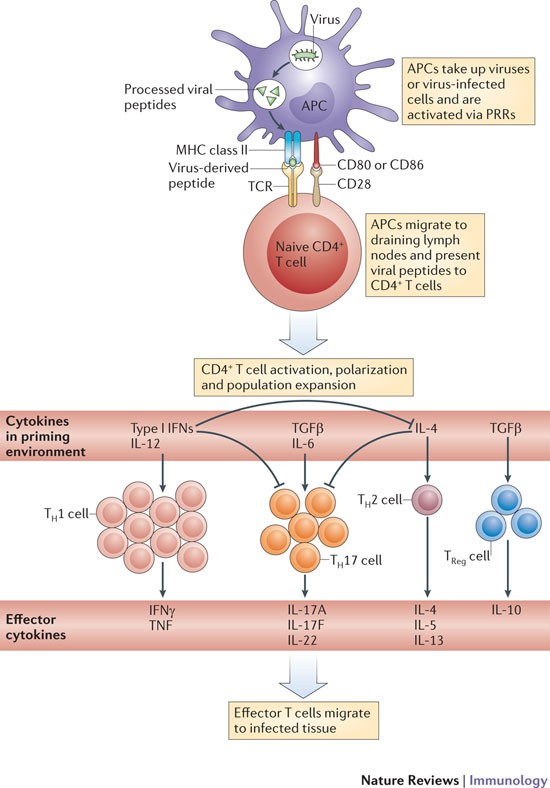
The crucial initial steps in generating primary antiviral T cell responses are the uptake of viral antigens by antigen-presenting cells (APCs) in infected tissue, the activation of APCs by pattern-recognition receptor (PRR) ligation, and the migration of these cells to draining lymph nodes. The nature of the viral infection, as well as PRR ligation, can influence the activation status of antigen-bearing APCs and the T helper (TH) cell-polarizing environment. The recognition of antigens on activated APCs by naive T cells during viral infection predominately results in the generation of TH1 cells owing to the presence of type I interferons (IFNs) and interleukin-12 (IL-12). However, TH17, TH2 and regulatory T (TReg) cell populations are also generated to some degree in certain viral infections. TCR, T cell receptor; TGFβ, transforming growth factor-β; TNF, tumour necrosis factor. |