BioAcyl Corp

BioAcyl Corp |
|
 |
 |
 |

|
Bohnacker, S., Hartung, F., Henkel, F., Quaranta, A., Kolmert, J., & Priller, A., et al. (2022). Mild COVID-19 imprints a long-term inflammatory eicosanoid- and chemokine memory in monocyte-derived macrophages. Mucosal Immunology, 1–10. Added by: Dr. Enrique Feoli (15/03/2022, 18:27) Last edited by: Dr. Enrique Feoli (15/03/2022, 18:32) |
 |
| Resource type: Journal Article Published DOI: 10.1038/s41385-021-00482-8 ID no. (ISBN etc.): 1935-3456 BibTeX citation key: Bohnacker2022 View all bibliographic details  |
Categories: BioAcyl Corp, BioAcyl Corp Subcategories: COVID-19, Inflammation resolution Creators: Bohnacker, Chaker, Erber, Esser-von Bieren, Giglberger, Hartung, Henkel, Knolle, Kolmert, Kugler, Lechner, Lingor, Pechtold, Priller, Protzer, Quaranta, Schmidt-Weber, Ud-Dean, Wheelock, Yazici Collection: Mucosal Immunology |
Views: 28/393
|
| Abstract |
|
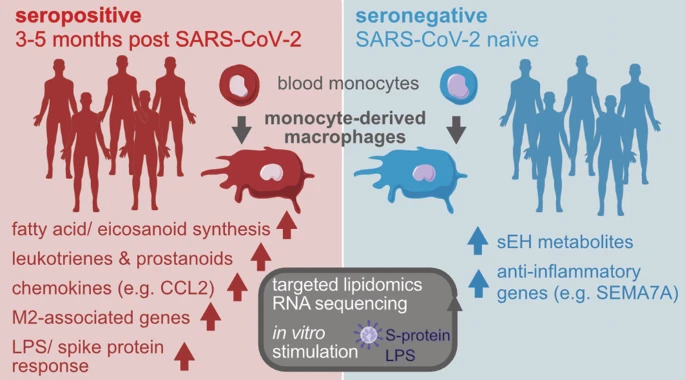
Monocyte-derived macrophages (MDM) drive the inflammatory response to severe acute respiratory syndrome coronavirus 2 (SARS-CoV-2) and they are a major source of eicosanoids in airway inflammation. Here we report that MDM from SARS-CoV-2-infected individuals with mild disease show an inflammatory transcriptional and metabolic imprint that lasts for at least 5 months after SARS-CoV-2 infection. MDM from convalescent SARS-CoV-2-infected individuals showed a downregulation of pro-resolving factors and an increased production of pro-inflammatory eicosanoids, particularly 5-lipoxygenase-derived leukotrienes. Leukotriene synthesis was further enhanced by glucocorticoids and remained elevated at 3–5 months, but had returned to baseline at 12 months post SARS-CoV-2 infection. Stimulation with SARS-CoV-2 spike protein or LPS triggered exaggerated prostanoid-, type I IFN-, and chemokine responses in post COVID-19 MDM. Thus, SARS-CoV-2 infection leaves an inflammatory imprint in the monocyte/ macrophage compartment that drives aberrant macrophage effector functions and eicosanoid metabolism, resulting in long-term immune aberrations in patients recovering from mild COVID-19.
|
| Notes |
|
Added by: Dr. Enrique Feoli Last edited by: Dr. Enrique Feoli |
 Publisher: Nature Publishing Group