BioAcyl Corp

BioAcyl Corp |
|
 |
 |
 |

|
He, F., Ru, X., & Wen, T. (2020). Nrf2, a transcription factor for stress response and beyond. International Journal of Molecular Sciences, 21(4777). Added by: Dr. Enrique Feoli (22/09/2025, 16:46) Last edited by: Dr. Enrique Feoli (22/09/2025, 18:18) |
 |
| Resource type: Journal Article Published DOI: 10.3390/ijms21134777 ID no. (ISBN etc.): 1422-0067 BibTeX citation key: He2020 View all bibliographic details  |
Categories: BioAcyl Corp, BioAcyl Corp Subcategories: Disease Tolerance, Homeostasis Creators: He, Ru, Wen Collection: International Journal of Molecular Sciences |
Views: 26/143
|
| Abstract |
|
Nuclear factor erythroid 2-related factor 2 (NRF2) is a transcription factor that regulates the cellular defense against toxic and oxidative insults through the expression of genes involved in oxidative stress response and drug detoxification. NRF2 activation renders cells resistant to chemical carcinogens and inflammatory challenges. In addition to antioxidant responses, NRF2 is involved in many other cellular processes, including metabolism and inflammation, and its functions are beyond the originally envisioned. NRF2 activity is tightly regulated through a complex transcriptional and post-translational network that enables it to orchestrate the cell’s response and adaptation to various pathological stressors for the homeostasis maintenance. Elevated or decreased NRF2 activity by pharmacological and genetic manipulations of NRF2 activation is associated with many metabolism- or inflammation-related diseases. Emerging evidence shows that NRF2 lies at the center of a complex regulatory network and establishes NRF2 as a truly pleiotropic transcription factor. Here we summarize the complex regulatory network of NRF2 activity and its roles in metabolic reprogramming, unfolded protein response, proteostasis, autophagy, mitochondrial biogenesis, inflammation, and immunity.
|
| Notes |
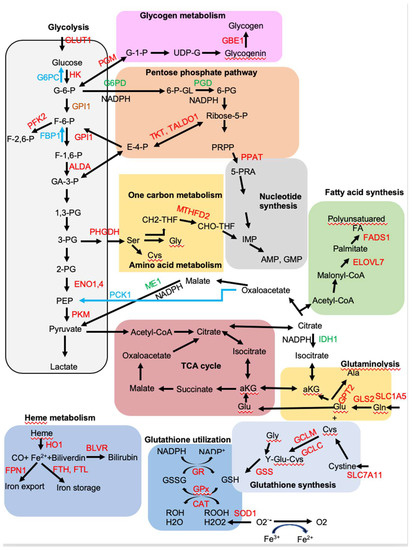
NRF2 regulates metabolism. NRF2 upregulates expression of genes involved in the glycolysis, glycogen metabolism, pentose phosphate pathway, one carbon metabolism, amino acid metabolism, nucleotide biosynthesis, glutaminolysis, fatty acid synthesis, heme metabolism, and glutathione synthesis and utilization (colored in red). NRF2 downregulates the expression of genes involved in the gluconeogenesis (colored in blue). Enzyme reactions that produce NADPH are indicated and colored in green. Enzyme abbreviations: ELOVL7, fatty acid elongase 7; FADS1, fatty acid desaturase 1; G6PD, glucose-6-phosphate dehydrogenase; GCLC, glutamate-cysteine ligase, catalytic subunit; GCLM, glutamate-cysteine ligase, modifier subunit; GLS2, glutaminase 2; GPT2, glutamic pyruvate transaminase; GSS, glutathione synthetase; IDH1, isocitrate dehydrogenase 1; ME1, malic enzyme 1; MTFHD2, methylenetetrahydrofolate dehydrogenase 2; PGD, 6-phosphogluconate dehydrogenase; PHGDH, phosphoglycerate dehydrogenase; PPAT, phosphoribosyl pyrophosphate amidotransferase; TALDO, transaldolase; TKT, transketolase; TXN, thioredoxin; SLC7A11, Solute Carrier Family 7 Member 11; SLC1A5, solute carrier family 1, member 5; HK1, hexokinase 1; GPI1 glucose phosphate isomerase 1; PFK2, 6-phosphofructo-2-kinase; ALDA, aldolase A, fructose-bisphosphate; Eno1,4, enolase 1 and enolase 4; PKM, pyruvate kinase, muscle; GR, glutathione reductase; GPx, glutathione peroxidase; SOD1, superoxide dismutase 1; CAT, catalase; HO-1, heme oxygenase-1; FPN1; ferroportin 1; BLVR, biliverdin reductase; FTH, ferritin heavy chain; FTL, ferritin light chain; PDM, phosphoglucomutase; GBE1, glycogen branching enzyme. Metabolite abbreviations: G-6-P, glucose 6-phosphate; G-1-P, glucose 1-phosphate; F-6-P, fructose 6-phosphate; F-1,6-BP, fructose 1,6-bisphosphate; F-2,6-BP, fructose 2,6-bisphosphate; GA-3-P, glyceraldehyde 3-phosphate; 1,3-PG, 1,3-phosphoglycerate; 3-PG, 3-phosphoglycerate; 2-PG, 2-phosphoglycerate; PEP, phosphoenolpyruvate; UDP-G, uracil-diphosphate glucose; 6-P-GL, 6-phosphogluconolactone; 6-PG, 6-phosphogluconate; R-5-P, ribulose 5-phosphate; 5-PRA, phosphoribosylamine; PRPP, 5-phosphoribosyl-α-1-pyrophosphate; THF, tetrahydrofolate; CH2-THF, 5,10-methylene-tetrahydrofolate; CHO-THF, 10-formyl- tetrahydrofolate; IMP, inosine monophosphate; AMP, adenosine monophosphate; GMP, guanosine monophosphate. Gly, glycine; Ala, alanine; Cys, cysteine; Glu, glutamate; Gln, glutamine; aKG, a-ketoglutarate; Y-Glu-Cys, gamma-glutamyl cysteine; Acetyl-CoA, acetyl-coenzyme A; NADPH, Nicotinamide adenine dinucleotide phosphate, reduced. Added by: Dr. Enrique Feoli Last edited by: Dr. Enrique Feoli |