BioAcyl Corp

BioAcyl Corp |
|
 |
 |
 |

|
Li, W., & Wang, Y. (2023). Stress granules: Potential therapeutic targets for infectious and inflammatory diseases. Frontiers in immunology, Volume 14 - 2023. Added by: Dr. Enrique Feoli (07/05/2025, 00:49) Last edited by: Dr. Enrique Feoli (07/05/2025, 01:15) |
 |
| Resource type: Journal Article Published DOI: 10.3389/fimmu.2023.1145346 ID no. (ISBN etc.): 1664-3224 BibTeX citation key: Li2023 View all bibliographic details  |
Categories: BioAcyl Corp Subcategories: Constitutive innate immunity Creators: Li, Wang Collection: Frontiers in immunology |
Views: 20/78
|
| Abstract |
|
Eukaryotic cells are stimulated by external pressure such as that derived from heat shock, oxidative stress, nutrient deficiencies, or infections, which induce the formation of stress granules (SGs) that facilitates cellular adaptation to environmental pressures. As aggregated products of the translation initiation complex in the cytoplasm, SGs play important roles in cell gene expression and homeostasis. Infection induces SGs formation. Specifically, a pathogen that invades a host cell leverages the host cell translation machinery to complete the pathogen life cycle. In response, the host cell suspends translation, which leads to SGs formation, to resist pathogen invasion. This article reviews the production and function of SGs, the interaction between SGs and pathogens, and the relationship between SGs and pathogen-induced innate immunity to provide directions for further research into anti-infection and anti-inflammatory disease strategies.
Added by: Dr. Enrique Feoli Last edited by: Dr. Enrique Feoli |
| Notes |
|
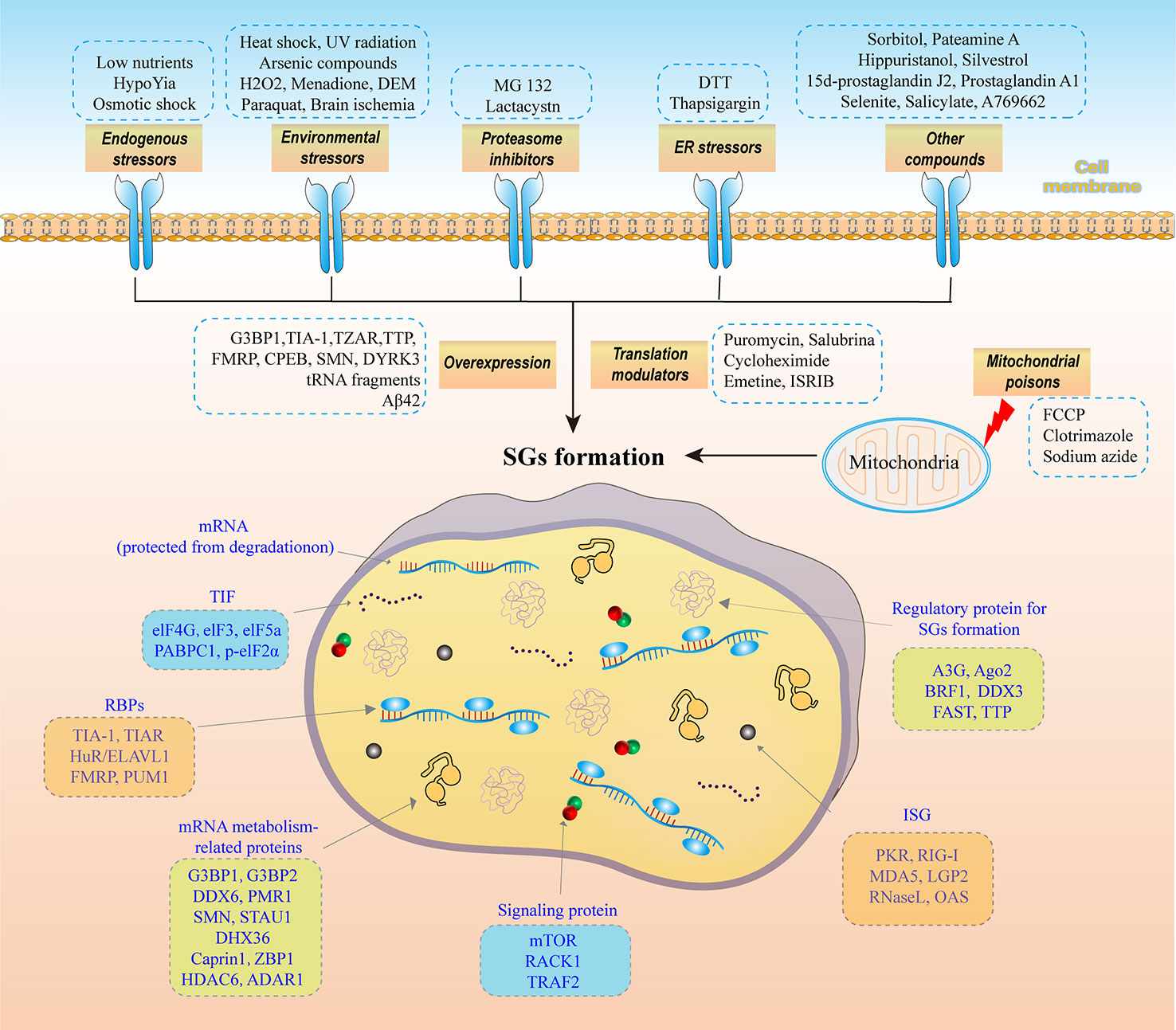
The main components of SGs and the factors that induce SGs formation. SGs comprise the following 7 components: (1) mRNAs that are protected from degradation. (2) TIFs targeting mRNAs, such as eIF4E, elF3, PABPC1, p-elF2α and elF5a; (3) RNA-binding proteins (RBPs) that regulate translation and protect mRNA stability, such as TIA-1, TIAR, HuR/ELAVL1, FMRP and PUM1; (4) mRNA metabolism-related proteins, such as G3BP1, G3BP2, DDX6, PMR1, SMN, STAU1, DHX36, caprin-1, ZBP1, HDAC6 and ADAR1; (5) signaling proteins, such as mTOR, RACK1 and TRAF; (6) expression products of interferon-stimulated genes (ISGs), such as PKR, RIG-I, MDA5 and LGP2, RNase L and OAS; and (7) regulatory proteins in SGs formation, such as APOBEC3G, Ago2, BRF1, DDX3, FAST and TTP. Added by: Dr. Enrique Feoli Last edited by: Dr. Enrique Feoli |