BioAcyl Corp

BioAcyl Corp |
|
 |
 |
 |

|
Falvo, E., Diviccaro, S., & Melcangi, R. C. (2020). Physiopathological role of neuroactive steroids in the peripheral nervous system. International Journal of Molecular Sciences, 21(23), 9000. Added by: Dr. Enrique Feoli (29/11/2023, 18:10) Last edited by: Dr. Enrique Feoli (30/11/2023, 10:33) |
 |
| Resource type: Journal Article Published DOI: 10.3390/ijms21239000 ID no. (ISBN etc.): 1422-0067 BibTeX citation key: Falvo2020 View all bibliographic details  |
Categories: BioAcyl Corp, BioAcyl Corp Subcategories: Oxytocin analgesia, Positive allosteric modulators Creators: Diviccaro, Falvo, Melcangi Collection: International Journal of Molecular Sciences |
Views: 25/154
|
| Abstract |
|
Peripheral neuropathy (PN) refers to many conditions involving damage to the peripheral nervous system (PNS). Usually, PN causes weakness, numbness and pain and is the result of traumatic injuries, infections, metabolic problems, inherited causes, or exposure to chemicals. Despite the high prevalence of PN, available treatments are still unsatisfactory. Neuroactive steroids (i.e., steroid hormones synthesized by peripheral glands as well as steroids directly synthesized in the nervous system) represent important physiological regulators of PNS functionality. Data obtained so far and here discussed, indeed show that in several experimental models of PN the levels of neuroactive steroids are affected by the pathology and that treatment with these molecules is able to exert protective effects on several PN features, including neuropathic pain. Of note, the observations that neuroactive steroid levels are sexually dimorphic not only in physiological status but also in PN, associated with the finding that PN show sex dimorphic manifestations, may suggest the possibility of a sex specific therapy based on neuroactive steroids. R: γ-amino butyric acid type A receptor; mPR: membrane progesterone receptor; P450scc: cytochrome P450 side chain cleavage; PR: progesterone receptor; StAR: Steroidogenic Acute Regulatory Protein; THP: Tetrahydroprogesterone; TSPO: Translocator protein-18kDa.
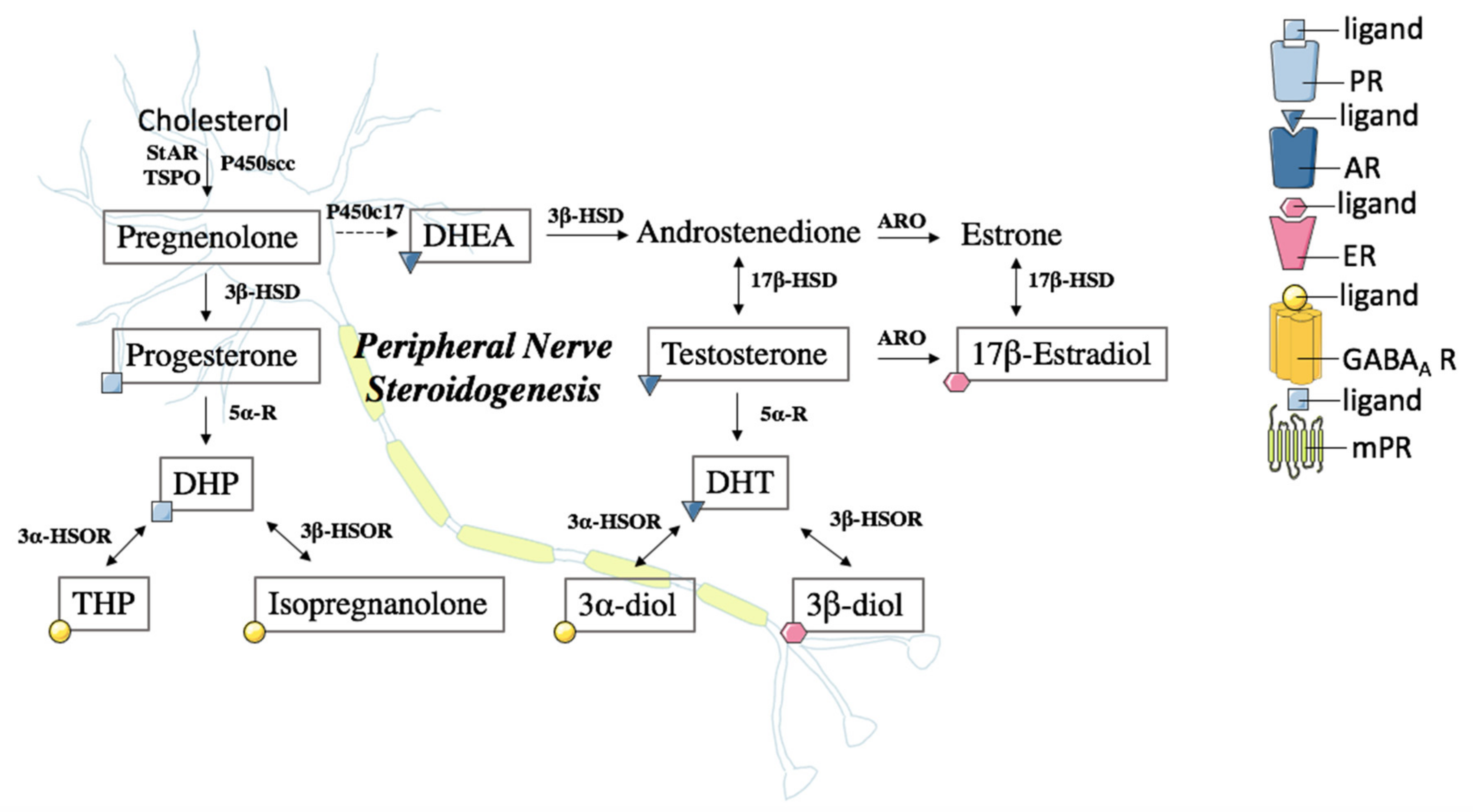
Steroidogenesis in the peripheral nervous system. Schematic representation of steroidogenic pathways. The arrows and bidirectional arrows indicate the irreversible and reversible reactions, respectively. The dashed line indicates a non-direct conversion. Steroids in squares represent molecules assessed by liquid chromatography tandem mass spectrometry in rat sciatic nerve. Further details are explained in the text. 3α-diol: 5α-androstane-3α,17β-diol; 3α-HSOR: 3α- hydroxysteroid oxidoreductase; 3β-diol: 5α-androstane-3β,17β-diol; 3β-HSD: 3β-hydroxysteroid dehydrogenase; 3β-HSOR: 3β-hydroxysteroid oxidoreductase; 5α-R: 5α-reductase; 17β-HSD: 17β-hydroxysteroid dehydrogenase; AR: Androgen receptor; ARO: Aromatase; DHEA: Dehydroepiandrosterone; DHP: Dihydroprogesterone; DHT: Dihydrotestosterone; ER: estrogen receptor; GABAA R: γ-amino butyric acid type A receptor; mPR: membrane progesterone receptor; P450scc: cytochrome P450 side chain cleavage; PR: progesterone receptor; StAR: Steroidogenic Acute Regulatory Protein; THP: Tetrahydroprogesterone; TSPO: Translocator protein-18kDa. |