BioAcyl Corp

BioAcyl Corp |
|
 |
 |
 |

|
Penesyan, A., Paulsen, I. T., Kjelleberg, S., & Gillings, M. R. (2021). Three faces of biofilms: A microbial lifestyle, a nascent multicellular organism, and an incubator for diversity. npj Biofilms and Microbiomes, 7(1), 80. Added by: Dr. Enrique Feoli (29/07/2023, 13:58) Last edited by: Dr. Enrique Feoli (29/07/2023, 17:47) |
 |
| Resource type: Journal Article Published DOI: 10.1038/s41522-021-00251-2 BibTeX citation key: Penesyan2021 View all bibliographic details  |
Categories: BioAcyl Corp Subcategories: Biofilms Creators: Gillings, Kjelleberg, Paulsen, Penesyan Collection: npj Biofilms and Microbiomes |
Views: 18/522
|
| Abstract |
|
Biofilms are organised heterogeneous assemblages of microbial cells that are encased within a self-produced matrix. Current estimates suggest that up to 80% of bacterial and archaeal cells reside in biofilms. Since biofilms are the main mode of microbial life, understanding their biology and functions is critical, especially as controlling biofilm growth is essential in industrial, infrastructure and medical contexts. Here we discuss biofilms both as collections of individual cells, and as multicellular biological individuals, and introduce the concept of biofilms as unique incubators of diversity for the microbial world.
|
| Notes |
|
https://www.nature.com/articles/s41522-021-00251-2.pdf
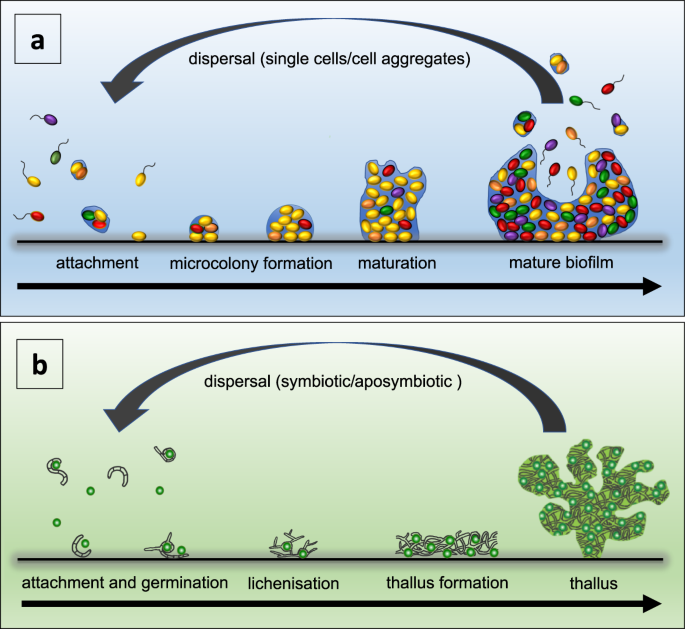
Panel a depicts the main stages of biofilm development, i.e., the attachment of cells/cell aggregates to a substratum, formation of microcolonies and their maturation, followed by dispersal of single motile cells and cell aggregates from biofilms. Panel b shows key stages involved in the vegetative reproduction of lichens, including the attachment and growth of symbiotic aggregates (consisting of fungal and algal cells) that are detached from the main lichen thallus, or via aposymbiotic dispersal and germination of fungi followed by re-engagement of algal partners and lichenisation94.
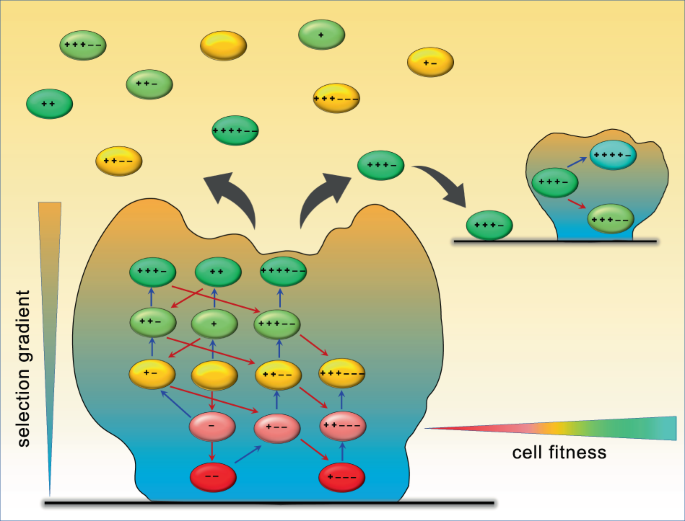
The biofilm mode of life and external stressors stimulate the generation of mutations in biofilm cells. The selection gradient that forms as a result of external stressors acts differentially on the various layers of cells. This allows the sequential generation of increasingly fit phenotypes under multiple rounds of mutation and increasing selection pressure. Cells with decreased fitness (as a result of initial mutations) can survive within the protective biofilm environment and accumulate mutations that can restore, or even increase their fitness. Upon dispersal from the parent biofilm, cells with decreased fitness perish without the protective shield of the biofilm, whereas cells with increased fitness have the potential to establish new biofilm communities where the further evolution of fitness can occur. Mutations leading to an increase in fitness are indicated by blue arrows followed by a ‘+’ sign, mutations leading to decreased fitness are indicated by red arrows and a ‘−’ sign. A limited number of variations is presented. Added by: Dr. Enrique Feoli Last edited by: Dr. Enrique Feoli |
| Quotes |
|
Beneficial microorganisms form biofilms associated with human, animal and plant hosts as an essential part of the holobiont8,9 . Conversely, biofilms are also responsible for some 80% of bacterial infections10
Added by: Dr. Enrique Feoli
(29/07/2023, 17:47)
|